Practice Huawei H12-831_V1.0 Online & Learning H12-831_V1.0 Mode
Wiki Article
BTW, DOWNLOAD part of Pass4guide H12-831_V1.0 dumps from Cloud Storage: https://drive.google.com/open?id=1OCl-zDqoc3KGICJ-1YQhZnxkIX05e2D_
With our top quality H12-831_V1.0 exam preparation materials, you will get Huawei certification and avail the excellent job opportunities available at the top ranking IT companies. Now you can easily pass H12-831_V1.0 Practice Test with the help of our valid learning materials and you will get a promotion in your company and work in a respectful and comfortable environment.
Huawei H12-831_V1.0 (HCIP-Datacom-Advanced Routing & Switching Technology V1.0) Exam is a certification exam that tests the knowledge and skills of IT professionals in the field of advanced routing and switching technology. H12-831_V1.0 Exam is designed to help IT professionals demonstrate their expertise in configuring and troubleshooting complex networks, including enterprise-level networks, WANs, and LANs.
>> Practice Huawei H12-831_V1.0 Online <<
Learning Huawei H12-831_V1.0 Mode & Latest H12-831_V1.0 Exam Simulator
Our Huawei H12-831_V1.0 practice test software is the most distinguished source for the Huawei H12-831_V1.0 exam all over the world because it facilitates your practice in the practical form of the HCIP-Datacom-Advanced Routing & Switching Technology V1.0 certification exam. Moreover, you do not need an active internet connection to utilize Huawei H12-831_V1.0 Practice Exam software. It works without the internet after software installation on Windows computers.
Huawei H12-831_V1.0 (HCIP-Datacom-Advanced Routing & Switching Technology V1.0) Exam is a professional certification exam designed for individuals who wish to validate their knowledge and skills in advanced routing and switching technologies. H12-831_V1.0 exam is designed to test the candidate's ability to plan, design, implement, operate, and troubleshoot complex enterprise-level networks using Huawei's routing and switching technologies. H12-831_V1.0 Exam covers a wide range of topics, including advanced routing protocols, switching technologies, MPLS, VPNs, network security, and network optimization.
Huawei HCIP-Datacom-Advanced Routing & Switching Technology V1.0 Sample Questions (Q363-Q368):
NEW QUESTION # 363
An OSPF network experiences frequent topology changes, leading to excessive CPU usage due to repeated SPF calculations. Which Huawei feature can reduce CPU utilization?
- A. MED optimization
- B. BGP add-path
- C. Incremental SPF (iSPF)
- D. OSPF cost auto-adjust
Answer: C
NEW QUESTION # 364
On the OSPF network shown in the figure, area 1 is a common area, area 2 is a stub area, and area 3 is an NSSA. R5 imports an external route 10.0.5.5/32. Given this, which of the following routers does not have the route 10.0.5.5/32 in its routing table?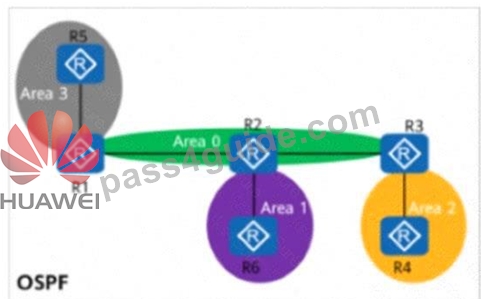
- A. R6
- B. R2
- C. R3
- D. R4
Answer: D
Explanation:
Comprehensive and Detailed In-Depth Explanation:In this OSPF network, we need to determine which router does not have the external route 10.0.5.5/32 in its routing table, based on the area types and OSPF behavior for external routes (Type 5 LSAs). Let's break it down step by step:
* Understanding the Network and Area Types:
* The network has multiple areas: Area 0 (backbone area), Area 1 (common area), Area 2 (stub area), and Area 3 (Not-So-Stubby Area or NSSA).
* Area 0 is the backbone area, connecting all other areas.
* Area 1 is a common (regular) area, which allows all types of LSAs, including external routes (Type 5 LSAs).
* Area 2 is a stub area, which does not allow external routes (Type 5 LSAs) to be propagated into it. Instead, a default route (0.0.0.0/0) is injected by the Area Border Router (ABR) to provide connectivity to external destinations.
* Area 3 is an NSSA, which allows limited external routes (Type 7 LSAs, translated to Type 5 LSAs by the ABR) but can block Type 5 LSAs depending on configuration. However, NSSAs typically allow external routes originated within the NSSA to be advertised into Area 0 and other areas.
* External Route Behavior (10.0.5.5/32):
* R5, located in Area 3 (NSSA), imports an external route 10.0.5.5/32. In an NSSA, external routes are advertised as Type 7 LSAs within the NSSA and are translated to Type 5 LSAs by the ABR (e.g., R1 or another router connecting Area 3 to Area 0) before being flooded into Area 0 and other areas.
* Type 5 LSAs (external routes) are flooded throughout the OSPF domain, except into stub areas and, in some cases, NSSAs (depending on configuration). However, stub areas block Type 5 LSAs entirely, replacing them with a default route.
* Analyzing Each Router's Area and Route Propagation:
* R1: Located in Area 0, R1 is an ABR connecting Area 0 to other areas (e.g., Area 1 and Area 3).
As an ABR, R1 receives the Type 7 LSA from R5 in Area 3, translates it to a Type 5 LSA, and floods it into Area 0 and other connected areas (except stub areas). Therefore, R1 will have the route 10.0.5.5/32 in its routing table.
* R2: Located in Area 0, R2 is also in the backbone area and will receive the Type 5 LSA flooded from Area 0. Thus, R2 will have the route 10.0.5.5/32 in its routing table.
* R3: Located in Area 2 (stub area), R3 does not receive Type 5 LSAs because stub areas block external routes. Instead, the ABR (likely R2 or another router connecting Area 2 to Area 0) injects a default route (0.0.0.0/0) into Area 2. Therefore, R3 will not have the specific route
10.0.5.5/32 in its routing table.
* R4: Located in Area 2 (stub area), R4, like R3, is in a stub area and does not receive Type 5 LSAs. It relies on the default route injected by the ABR. Thus, R4 will not have the route 10.0.5.5
/32 in its routing table.
* R5: Located in Area 3 (NSSA), R5 originates the external route 10.0.5.5/32 and advertises it as a Type 7 LSA within Area 3. R5 will have this route in its routing table.
* R6: Located in Area 1 (common area), R6 receives the Type 5 LSA flooded from Area 0 (via R1 or another ABR). Therefore, R6 will have the route 10.0.5.5/32 in its routing table.
* Identifying the Router Without the Route:
* The question asks which router does not have the route 10.0.5.5/32 in its routing table.
* R3 and R4 are both in Area 2 (stub area), which blocks Type 5 LSAs. Therefore, neither R3 nor R4 will have the route 10.0.5.5/32.
* R6 (Area 1, common area) and R2 (Area 0, backbone) will have the route, as will R1 (Area 0 and ABR) and R5 (Area 3, NSSA, originator).
* The options provided are R6, R3, R4, and R2. Among these, R3 and R4 do not have the route, but we need to select one correct answer from the options. Given the typical focus of such questions on identifying a single router in a stub area, and considering the placement of R4 in the diagram (Area 2), R4 is the most likely answer, as it is clearly in the stub area and isolated from external routes.
* Conclusion:
* R4, located in Area 2 (stub area), does not have the route 10.0.5.5/32 in its routing table because stub areas block Type 5 LSAs, and only a default route is provided by the ABR.
* Therefore, the correct answer is C (R4).
References (Based on HCIP-Datacom-Advanced Routing & Switching Technology Concepts):
* OSPF Area Types: HCIP-Datacom documentation on OSPF area configurations, including stub areas, NSSAs, and common areas (e.g., Section on OSPF LSA Types and Area Restrictions).
* External Route Propagation: HCIP-Datacom coverage of Type 5 and Type 7 LSAs, their flooding behavior, and restrictions in stub and NSSA areas (e.g., Chapter on Advanced OSPF Features).
* ABR and ASBR Roles: HCIP-Datacom explanation of Area Border Routers (ABRs) and Autonomous System Boundary Routers (ASBRs) in OSPF networks (e.g., Section on Route Redistribution and External Route Handling).
NEW QUESTION # 365
By default, LDP adjacencies will trigger the establishment of LSP based on the IP routing of the 32bit address.
- A. TRUE
- B. FALSE
Answer: A
NEW QUESTION # 366
The output information of a switch is shown in the figure. Which of the following can be determined from this information?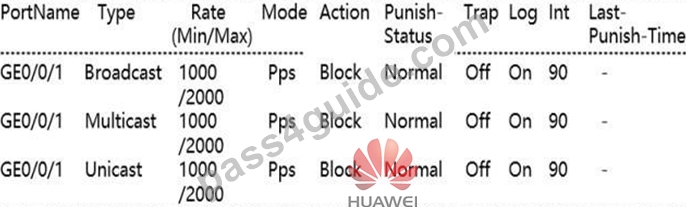
- A. The administrator configured the traffic suppression function on the GE0/0/1 port of the switch.
- B. When the average rate of unknown multicast packets is 1500 pps, GE0/0/1 will block the multicast packets.
- C. When the average rate of unicast packets is known to be 2500 pps, GE0/0/1 will be closed
- D. After GE0/0/1 blocks broadcast packets, they will be forwarded normally only when the average rate of broadcast packets is less than 1000ps.
Answer: D
NEW QUESTION # 367
On the network shown in the figure, EBGP peer relationships are established between ASs through directly connected interfaces.
* OSPF is deployed in AS 65456 (with OSPF disabled on interconnected interfaces between ASs).
* R4 and R5 use Loopback0 to establish iBGP peer relationships with R6.
* The IP address of Loopback0 on each router is 10.0.X.X/32, and the router ID is 10.0.X.X, where X is the number of the router.
* R1, R2, and R3 import the external route 192.168.1.0/24 into BGP through the import-route command.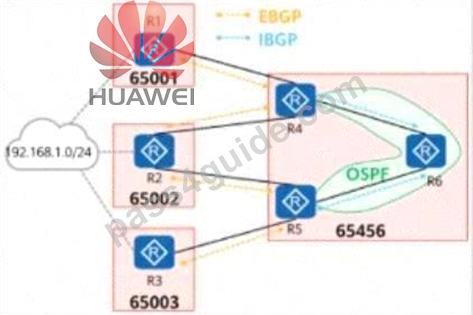
Which of the following statements are true?
- A. For 192.168.1.0/24, R5 preferentially selects the route received from R2.
- B. For 192.168.1.0/24, R6 preferentially selects the route received from R4.
- C. For 192.168.1.0/24, R4 preferentially selects the route received from R1.
- D. For 192.168.1.0/24, if the default local-preference 150 command is configured on R3, R5 preferentially selects the route received from R3.
Answer: A,D
Explanation:
Comprehensive and Detailed In-Depth Explanation:
Understanding the BGP and OSPF Network Topology in the Question:
* External Route Importation
* R1, R2, and R3 import 192.168.1.0/24 into BGP from an external source.
* This means R1, R2, and R3 will advertise this route to their EBGP and iBGP peers.
* BGP Route Selection Criteria
* BGP follows specific rules to determine the best path for a route. The most relevant factors here are:
* Highest Local Preference (LOCAL_PREF) # Preferred
* Shortest AS Path # Preferred
* Lowest Origin Type (IGP < EGP < Incomplete) # Preferred
* Lowest MED (Multi-Exit Discriminator) # Preferred
* Oldest eBGP route (if paths are equal) # Preferred
Route Selection Analysis for Each Statement:
A: For 192.168.1.0/24, R5 preferentially selects the route received from R2. # (Correct)
* R5 is in AS 65456 and peers with R6 using iBGP.
* Since R2 is a central router with direct connectivity to R5, it is the most preferred path compared to indirect paths from R1 or R3.
* By default, R5 will prefer the path from R2 over others unless explicitly influenced by BGP attributes.
# Statement A is correct.
B: For 192.168.1.0/24, R4 preferentially selects the route received from R1. # (Incorrect)
* R4 and R5 use Loopback0 to establish iBGP with R6, meaning they receive BGP routes from multiple sources.
* BGP prefers the shortest AS path, and there is no specific information indicating that R1's path is the shortest for R4.
* R4 may actually prefer another router's advertisement (e.g., R2 or R3) depending on AS path length and other attributes.
# Statement B is incorrect.
C: For 192.168.1.0/24, if the default local-preference 150 command is configured on R3, R5 preferentially selects the route received from R3. # (Correct)
* By default, BGP assigns a local-preference of 100.
* If R3 sets local-preference to 150, it is higher than other routes (R1, R2).
* BGP prefers the highest local-preference value, so R5 will prefer the route received from R3 if this attribute is set.
# Statement C is correct.
D: For 192.168.1.0/24, R6 preferentially selects the route received from R4. # (Incorrect)
* R6 is an iBGP peer of both R4 and R5.
* BGP best-path selection depends on attributes like local-preference, AS-path, and MED.
* There is no explicit information suggesting that R4's advertisement is preferred over R5's.
* R6 may prefer R5's route depending on attributes.
# Statement D is incorrect.
Final Conclusion:
# A. R5 preferentially selects the route received from R2.# B. R4 does not necessarily prefer R1's route.
# C. If R3 sets local-preference 150, R5 will prefer the route from R3.# D. R6 does not necessarily prefer R4's route.
Thus, the correct answers are: A, C.
NEW QUESTION # 368
......
Learning H12-831_V1.0 Mode: https://www.pass4guide.com/H12-831_V1.0-exam-guide-torrent.html
- Latest H12-831_V1.0 Mock Test ???? H12-831_V1.0 Exam Questions And Answers ???? H12-831_V1.0 Study Guides ???? Download 「 H12-831_V1.0 」 for free by simply entering ( www.examcollectionpass.com ) website ????New H12-831_V1.0 Exam Question
- 100% Pass 2026 Useful H12-831_V1.0: Practice HCIP-Datacom-Advanced Routing & Switching Technology V1.0 Online ???? Search for ⮆ H12-831_V1.0 ⮄ and easily obtain a free download on [ www.pdfvce.com ] ????H12-831_V1.0 Trustworthy Exam Content
- Download the Actual Huawei H12-831_V1.0 Exam Questions with Free Updates ???? Go to website 《 www.vce4dumps.com 》 open and search for 「 H12-831_V1.0 」 to download for free ☸H12-831_V1.0 copyright Downloads
- H12-831_V1.0 Exam Questions Available At High Discount With Free Demo ???? Immediately open “ www.pdfvce.com ” and search for ➡ H12-831_V1.0 ️⬅️ to obtain a free download ????New H12-831_V1.0 Exam Question
- Cost Effective H12-831_V1.0 Dumps ???? Cost Effective H12-831_V1.0 Dumps ???? H12-831_V1.0 Training Materials ???? Easily obtain “ H12-831_V1.0 ” for free download through 【 www.pdfdumps.com 】 ????Valid H12-831_V1.0 Exam Voucher
- H12-831_V1.0 Exam Questions And Answers ???? H12-831_V1.0 copyright Downloads ???? H12-831_V1.0 Study Guides ???? Open website ➥ www.pdfvce.com ???? and search for 「 H12-831_V1.0 」 for free download ????H12-831_V1.0 copyright Downloads
- Reliable H12-831_V1.0 Test Review ⬇ H12-831_V1.0 Trustworthy Exam Content ???? H12-831_V1.0 Exam Questions And Answers ???? Enter 【 www.practicevce.com 】 and search for ⏩ H12-831_V1.0 ⏪ to download for free ????H12-831_V1.0 Study Guides
- Valid H12-831_V1.0 Exam Voucher ???? H12-831_V1.0 Exam Questions And Answers ???? H12-831_V1.0 Valid Study Notes ???? Easily obtain free download of ⇛ H12-831_V1.0 ⇚ by searching on ➽ www.pdfvce.com ???? ????Latest H12-831_V1.0 Mock Test
- 100% Pass 2026 Useful H12-831_V1.0: Practice HCIP-Datacom-Advanced Routing & Switching Technology V1.0 Online ???? Search on ➠ www.dumpsquestion.com ???? for ⏩ H12-831_V1.0 ⏪ to obtain exam materials for free download ????Latest H12-831_V1.0 Exam Dumps
- Reliable H12-831_V1.0 Test Review ???? Reliable H12-831_V1.0 Exam Simulator ???? H12-831_V1.0 Study Guides ???? Search for ▛ H12-831_V1.0 ▟ and download it for free on ⮆ www.pdfvce.com ⮄ website ✴H12-831_V1.0 Trustworthy Exam Content
- Test H12-831_V1.0 Answers ???? H12-831_V1.0 copyright Downloads ???? New H12-831_V1.0 Study Guide ???? Download ➡ H12-831_V1.0 ️⬅️ for free by simply searching on 【 www.examcollectionpass.com 】 ????H12-831_V1.0 Study Guides
- hubwebsites.com, telebookmarks.com, lewisalcv308304.wikiparticularization.com, coolbizdirectory.com, wwndirectory.com, glowingdirectory.com, a-listdirectory.com, www.stes.tyc.edu.tw, rafaeljtpu508426.blogpayz.com, cool-directory.com, Disposable vapes
P.S. Free & New H12-831_V1.0 dumps are available on Google Drive shared by Pass4guide: https://drive.google.com/open?id=1OCl-zDqoc3KGICJ-1YQhZnxkIX05e2D_
Report this wiki page